French Utility Bills Vocabulary
Understand French electricity, gas, and water bills: contracts, meter readings, estimates, charges, payment, and useful customer-service phrases.
A French utility bill mixes everyday language with contractual and accounting terms. Knowing électricité or eau is not enough when the document asks for a relevé de compteur, distinguishes an estimation from actual consumption, or carries a régularisation from an earlier period. The most useful approach is to follow the life of the bill: contract, meter, consumption, charges, payment, and any dispute.
Quick answer
On a French utility bill, identify the billing period, meter reading, actual or estimated consumption, subscription, taxes, total due, and payment deadline before comparing prices.
Overview: start with the contract and account
The top of the document identifies who supplies the service and which contract is being billed. A numéro de client identifies you with the supplier; a numéro de contrat identifies the agreement. The point de livraison or PDL identifies an electricity delivery point, while gas documents may use PCE. Keep these references ready when contacting support.
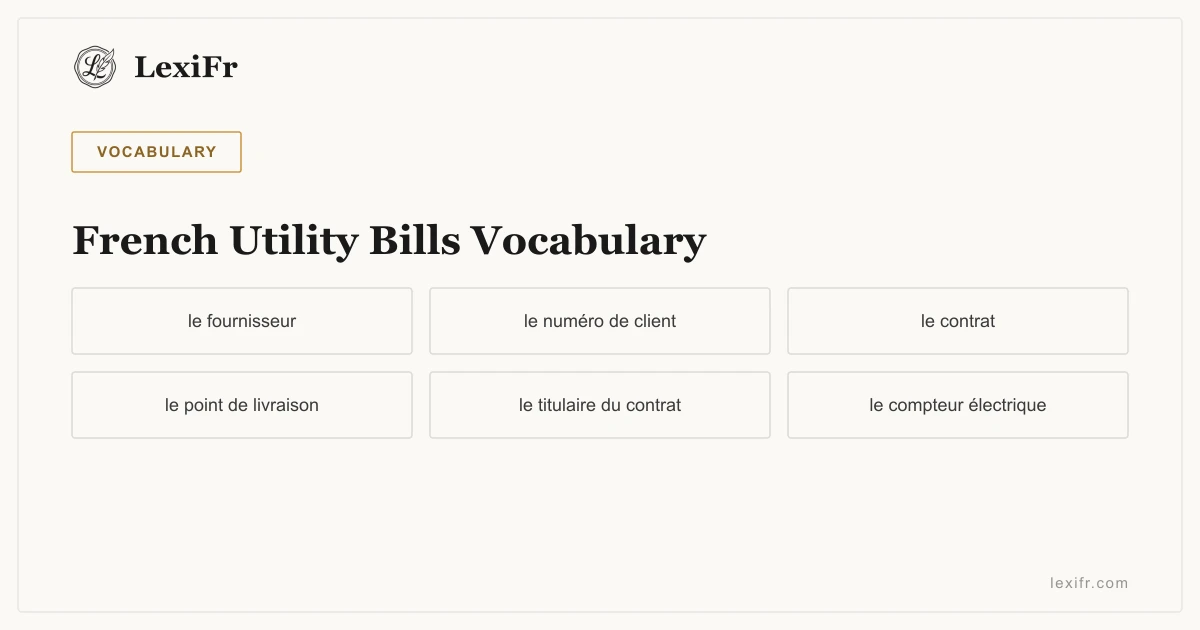
le fournisseur → supplier
le numéro de client → customer number
le contrat → contract
le point de livraison → delivery point
le titulaire du contrat → account holder
Essential words: read the meter information
A compteur measures consumption. A relevé is a reading, and an index is the number recorded on a given date. The bill may distinguish an index relevé from an index estimé. With a smart meter, transmission may be automatic, but the vocabulary of readings remains central when checking a discrepancy.
le compteur électrique → electricity meter
le relevé de compteur → meter reading
l’index précédent → previous reading
l’index actuel → current reading
une consommation estimée → estimated consumption
Consumption is not the whole price
The variable part usually depends on kilowatt-hours for electricity or gas and cubic metres for water. The bill can show a prix unitaire and a quantity consumed. Comparing only the total can mislead because the covered period, tariff, and fixed subscription may differ.
la consommation → consumption
un kilowattheure (kWh) → a kilowatt-hour
un mètre cube (m³) → a cubic metre
le prix unitaire → unit price
la période de facturation → billing period
Context groups: subscriptions, charges, and taxes
L’abonnement is the fixed contractual charge, even when consumption is low. Other lines may include acheminement, contributions, taxes, or service charges. The exact labels vary by utility and contract, so separate fixed charges from consumption before deciding what caused an increase.
l’abonnement mensuel → monthly subscription
les frais fixes → fixed charges
les taxes et contributions → taxes and contributions
le montant hors taxes → amount before tax
le montant toutes taxes comprises → amount including all taxes
What the amount and dates mean
Montant à payer is the amount due. Date d’échéance is the payment deadline, not necessarily the billing date. A prélèvement automatique debits the registered bank account. If the supplier bills a stable monthly instalment, mensualité names that payment; a later adjustment reconciles payments with real consumption.
The main lines to locate on a French utility bill
| Bill area | French label | What it tells you | What to verify |
|---|---|---|---|
| billing period | période de facturation | The dates covered by the bill | Compare like-for-like periods. |
| meter evidence | index relevé ou estimé | Whether consumption was measured or projected | Check the date and meter number. |
| fixed portion | abonnement | The charge owed independently of usage | Confirm the subscribed tariff. |
| variable portion | consommation en kWh ou m³ | The quantity billed | Compare previous and current readings. |
| payment | montant à payer | The balance requested | Separate credits and earlier payments. |
| deadline | date d’échéance | The date payment is due | Do not confuse it with the issue date. |
le montant à payer → amount due
la date d’échéance → payment deadline
le prélèvement automatique → direct debit
une mensualité → monthly instalment
un solde créditeur → credit balance
Estimated bills and regularisation
An estimation is not automatically an error; it uses a projected reading when actual data is unavailable. A facture de régularisation compares previous instalments or estimates with recorded consumption. The result can be an additional payment or a credit. Check the index dates and period before challenging the amount.
une facture estimative → estimated bill
une facture de régularisation → adjustment bill
un trop-perçu → overpayment
un remboursement → refund
un complément à payer → additional amount due
Useful phrases for customer service
A precise question gets a more useful answer than “My bill is wrong.” State the billing period, identify the disputed reading or line, and request the calculation. Keep copies of the bill and any meter photo. These phrases remain neutral and practical without making legal claims.
Je voudrais vérifier le relevé utilisé pour cette facture. → I would like to check the reading used for this bill.
Cette consommation est-elle réelle ou estimée ? → Is this consumption actual or estimated?
Pouvez-vous m’expliquer cette ligne de frais ? → Can you explain this charge line?
La date du relevé ne correspond pas à mon état des lieux. → The reading date does not match my property inspection report.
Merci de m’envoyer le détail du calcul. → Please send me the calculation details.
Billing vocabulary mistakes to avoid
Do not translate facture only as “invoice” and miss that it is the ordinary word for a household bill. Échéance can mean a deadline or scheduled payment, not a power outage. Do not confuse relevé de compteur with relevé bancaire. Finally, compare the same unit and billing period before concluding that a tariff changed.
J’ai reçu ma facture d’électricité. → I received my electricity bill.
Le paiement arrive à échéance lundi. → The payment falls due on Monday.
Il y a une coupure de courant. → There is a power outage.
Je consulte mon relevé bancaire. → I am checking my bank statement.
A memory and review plan
Organise the vocabulary into five questions: who supplies, what meter, how much consumption, which fixed charges, and when payment is due. On a real bill, highlight one answer for each question. Review phrases as complete chunks because customer-service language depends on verbs such as vérifier, expliquer, contester, and rembourser. This five-part map also makes later bills quicker to scan.
Practice reading a mini bill
Imagine a bill covering January and February. The previous reading is 4,820 kWh, the new reading is 5,140 kWh, and both are actual. Consumption is therefore 320 kWh. Now locate the subscription, taxes, total due, and deadline. If the new reading were estimated, the first support question should concern the index used.
La facture couvre les mois de janvier et février. → The bill covers January and February.
La consommation facturée est de 320 kWh. → The billed consumption is 320 kWh.
Le règlement doit parvenir avant le 15 mars. → Payment must arrive before 15 March.
Questions about French bills
The FAQ distinguishes the billing document, meter evidence, adjustment process, and payment vocabulary.
Remember the word, not just recognise it.
LexiFr turns a page of vocabulary into a review deck that comes back just as you are about to forget it, each word shown the way it is actually used.
Free to start - no ads, no streak guilt. Your first 200 words are waiting.
Questions about this note
What is the difference between une facture and un reçu?
A facture requests or records an amount billed. A reçu confirms that payment or another transaction has been received.
What does relevé de compteur mean?
It is a meter reading: the recorded index used to calculate consumption over a period.
What is a facture de régularisation?
It reconciles estimates or monthly instalments with recorded consumption and may produce an extra amount due or a credit.
Does échéance mean the bill date?
Not usually. Date d’échéance is the deadline or scheduled due date for payment.