Femme vs Meuf: Register and Usage
Femme and meuf can both refer to a woman, but their register and social effect differ. Learn where each sounds natural and when to avoid meuf.
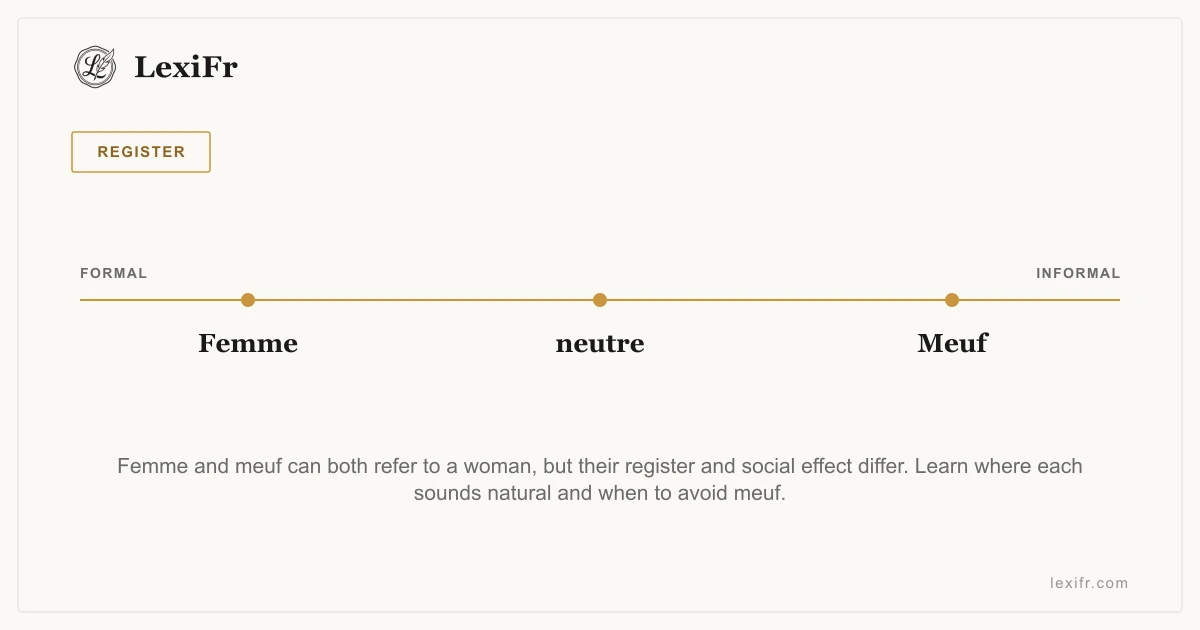
Femme and meuf may identify the same person, but they do not create the same social scene. Femme is the standard word for an adult woman and can also mean wife in possessive contexts. Meuf is verlan, strongly informal, and tied to familiar speech. The important lesson is not simply “formal versus slang”: speakers choose a term in relation to audience, tone, age, intimacy, and whether they are speaking about someone or addressing her.
Quick answer
Use femme as the neutral standard word for “woman,” and sometimes “wife.” Meuf is informal verlan for “woman” or “girl” and needs a familiar context.
Quick answer: the neutral ground belongs to femme
Femme works in conversation, journalism, administration, introductions, and respectful description. Nothing about it is stiff. With a possessive determiner it can mean wife, while une femme usually means a woman. Context normally resolves the two readings without difficulty.
Une femme attend à l’accueil. → A woman is waiting at reception.
Ma femme travaille à Bordeaux. → My wife works in Bordeaux.
C’est une femme très drôle. → She is a very funny woman.
Formal, neutral, informal, and slang scale: what meuf signals
Meuf comes from the verlan reversal of femme. It signals a relaxed peer-group register before it contributes factual information. Younger speakers may use it casually, but frequency varies by person and community. It can sound friendly, dismissive, objectifying, or simply ordinary within a group; vocabulary alone does not settle the tone.
J’ai parlé avec une meuf de ma classe. → I spoke with a girl/woman from my class.
Cette meuf est vraiment sympa. → That woman/girl is really nice.
Il y avait deux meufs devant le cinéma. → There were two women/girls outside the cinema.
Appropriateness guidance: talking about someone is not addressing her
Learners sometimes hear meuf among friends and assume it is a casual form of address. Calling someone meuf directly can sound abrupt, comic, or disrespectful unless that usage is established in the group. A person’s name, madame in a service encounter, or no noun at all is usually safer. The same caution applies to collective forms such as les meufs. Within an established group it can be inclusive and warm; from an outsider it may reduce people to a category. When unsure, address the group directly with vous, tout le monde, or names rather than testing a slang label.
Excusez-moi, madame, vous avez fait tomber ceci. → Excuse me, ma’am, you dropped this.
Salut, Inès, tu viens ? → Hi, Inès, are you coming?
Hé, meuf ! → Hey, girl!
This needs a relationship and tone that make it acceptable.
When each word is acceptable: a practical register spectrum
In neutral public French, choose femme. In a familiar conversation where everyone naturally uses verlan, meuf may fit. In professional writing, customer service, school communication, or speech about an unknown person, femme is dependable. The choice is social, not a test of how “authentic” your French sounds. Media quotation and fiction add another layer: a writer may reproduce meuf to characterise a voice without endorsing that voice as neutral. Learners reading dialogue should separate recognition from imitation. A word that is authentic for a fictional speaker may still be the wrong choice in their own conversation.
How audience and context affect the safest choice
| Situation | Natural choice | French example | Register note |
|---|---|---|---|
| neutral description | femme | Une femme vous attend dans le hall. | Standard and suitable almost everywhere. |
| professional role matters | role or name | La responsable vous répondra demain. | The role is more useful than a gender label. |
| relaxed peer conversation | meuf may fit | J’ai discuté avec une meuf du quartier. | Strongly informal and dependent on group usage. |
| polite direct address | madame or name | Madame, votre table est prête. | Meuf is not a neutral form of address. |
La femme qui a appelé a laissé un message. → The woman who called left a message.
On retrouve les meufs au café ? → Shall we meet the girls at the café?
Informal peer-group language.
Nous recherchons une femme ayant de l’expérience. → We are looking for a woman with experience.
A formal context requires the standard term.
Woman, wife, girl, and girlfriend
English labels do not map neatly. Femme can mean wife after ma, ta, or sa. Fille means girl or daughter and can refer informally to young women, while petite amie explicitly means girlfriend. Meuf sometimes corresponds to “girl” in casual English, but it does not automatically mean girlfriend.
Je te présente ma femme. → Let me introduce you to my wife.
Leur fille étudie à Lille. → Their daughter studies in Lille.
C’est sa petite amie. → She is his girlfriend.
Common mistakes and tone risks
Do not use meuf merely to prove familiarity with slang. Avoid it in formal biographies and when the person’s dignity or professional role is relevant. Do not assume femme is impolite because English “female” can sound clinical; French une femme is the ordinary human noun. Also avoid translating ma femme as “my woman” when it clearly means wife.
C’est la médecin qui m’a reçu. → She is the doctor who saw me.
A role may be more relevant than a gender label.
Cette femme dirige l’équipe. → This woman leads the team.
A memory check before speaking
Ask two questions: would you comfortably use slang with this audience, and does the noun add useful information? If either answer is no, choose femme, a name, a role, or omit the label. Register control often means choosing the quieter word.
Practice changing audience
Describe the same encounter to a close friend and in an email to a colleague. The friend version may contain meuf if that matches your normal voice; the email should use femme or the person’s role. Then practise the wife meaning with ma femme so you hear how possession changes interpretation.
J’ai rencontré une meuf super sympa au concert. → I met a really nice woman at the concert.
J’ai rencontré une femme qui travaille avec notre client. → I met a woman who works with our client.
Questions about usage and politeness
The answers below keep the distinction flexible enough for real social variation while giving learners a safe default.
Say it in the right room.
LexiFr reviews words like this alongside their register, so you know which one belongs in an email and which belongs at a cafe.
Free to start - no ads, no streak guilt. Your first 200 words are waiting.
Questions about this note
Is meuf offensive?
Not automatically, but it is strongly informal and can sound disrespectful or objectifying depending on speaker, audience, and tone.
Can a woman use meuf?
Yes. The word is not restricted by the speaker’s gender, though individual and group preferences vary.
Does femme mean woman or wife?
Une femme normally means a woman. Ma femme, ta femme, or sa femme commonly means wife.
Should learners use meuf?
Understand it first. Use it only when the surrounding group genuinely uses that register and you are confident about the relationship.