Déception vs Deception: A Classic False Friend
Learn why French déception means disappointment, how to express deception accurately, and how to avoid this high-risk false friend.
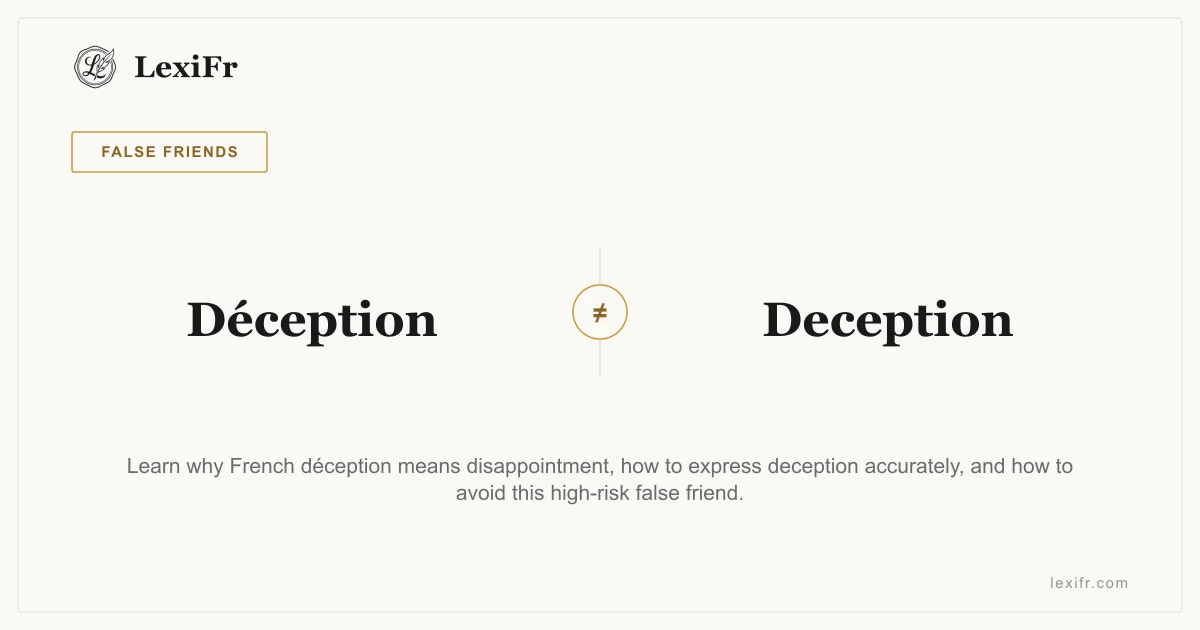
A French déception is what you feel when reality fails to meet your hopes: disappointment. English “deception” names the act or result of misleading someone. Because the spellings nearly coincide, a serious accusation can accidentally become a comment about hurt feelings-or the other way round.
Quick answer
French déception means disappointment, let-down, or frustrated expectation. For English “deception,” choose tromperie, supercherie, mensonge, or manipulation according to the method and seriousness. The related verb décevoir means disappoint; deceiving someone is tromper quelqu’un. Keep emotion and dishonest action in separate columns.
Quick answer
The reliable distinction is conceptual: déception belongs to the disappointed person’s reaction, while tromperie and related nouns belong to misleading conduct. French décevoir changes someone’s hopes; tromper changes what they believe. Check whose experience the sentence describes before choosing a cognate.
What the French word really means
Une déception is an unmet hope, an unsatisfactory result, or the feeling produced by it. It can range from a minor let-down to deep personal disappointment. The plural déceptions often looks back on several failed expectations, not several schemes to mislead people.
Why English speakers confuse it
Both words come through a history of taking or catching, but modern French and English divided the semantic territory differently. Visual similarity encourages a fast translation before the sentence’s roles are clear. A person éprouve une déception; another person commet une tromperie. Those verb partners expose the split.
Wrong vs right examples
Use the table to separate emotional outcome from dishonest method. The replacements are not interchangeable synonyms: mensonge centres on a false statement, tromperie on deception broadly, supercherie on an engineered trick, and fraude on rule-breaking for gain.
Disappointment or deception?
| Intended idea | Natural French | Avoid | Reason |
|---|---|---|---|
| disappointment | une déception | une tromperie | reaction to unmet hopes |
| deceive someone | tromper quelqu’un | décevoir quelqu’un | mislead rather than disappoint |
| a false statement | un mensonge | une déception | focus on the lie |
| fraudulent deception | une fraude / supercherie | une simple déception | deliberate scheme |
Le résultat du concours est une vraie déception. → The competition result is a real disappointment.
Cette publicité repose sur une tromperie. → This advertisement relies on deception.
Son mensonge a détruit leur confiance. → His lie destroyed their trust.
La supercherie a été découverte rapidement. → The hoax was discovered quickly.
Natural replacements for English “deception”
Tromperie is the broad everyday noun. Supercherie suggests a trick, hoax, or elaborate deceit. Mensonge is a lie, manipulation stresses influence, and fraude applies where dishonest conduct breaks financial, legal, or procedural rules. Select the noun that identifies the act rather than merely sounding cognate.
On l’a trompée sur la qualité du produit. → She was deceived about the product’s quality.
Les enquêteurs soupçonnent une fraude organisée. → Investigators suspect organised fraud.
Common mistakes to avoid
Do not use déception when accusing someone of dishonesty; it reports disappointment. Do not overcorrect by translating every disappointment as tristesse, which is general sadness. Preserve the accents in edited French: deception without them is not the standard spelling of déception.
Je ne veux pas vous décevoir. → I do not want to disappoint you.
Cette promesse non tenue nous a beaucoup déçus. → This broken promise disappointed us greatly.
Register, responsibility, and tone
Déception is neutral and can be tactful: le résultat est décevant evaluates an outcome without alleging intent. Fraude and escroquerie are serious accusations that may carry legal implications. In uncertain situations, describe the misleading claim precisely rather than escalating from disappointment to criminal vocabulary.
Memory device: feeling versus act
Imagine two sides of a theatre curtain. Behind the curtain, someone stages a tromperie; in front of it, the audience later feels une déception. Ask whether the sentence names the misleading act or the emotional result. That single role check prevents the false friend.
Practice: repair the accusation
Translate four scenarios: a disappointing meal, a deliberate false claim, a friend who lets you down, and a financial scheme. Then reverse the subjects: make one person décevoir another, and make a different person tromper another. Explain why the verbs cannot swap without changing the event.
Case workshop: trace cause and reaction
Build a short case in two columns. In the first, record the misleading statement, the person responsible, and the French noun that identifies the act. In the second, record the expectation that failed and the resulting emotional response. Now remove deliberate intent: the disappointment can remain even though the deception disappears. Finally, imagine a legally significant scheme and decide whether tromperie is precise enough or whether fraude or escroquerie is required. This method keeps motive, action, evidence, and feeling separate. It also prevents a mild restaurant let-down from receiving the vocabulary of criminal conduct, and prevents a deliberate lie from being reduced to somebody’s subjective disappointment. For a final variation, let the facts remain uncertain. Describe only what can be observed, reserve accusations until evidence supports them, and use décevant for the unsatisfactory outcome without implying a dishonest motive. Precision protects both meaning and tone. Recheck the roles before choosing.
La nouvelle a provoqué une profonde déception. → The news caused deep disappointment.
Le faux document visait à induire les clients en erreur. → The false document was intended to mislead customers.
Related false friends and final check
Before following the related links, state the contrast without using English cognates: one family concerns failed hopes; the other concerns false belief created deliberately. Revisit the four replacement nouns tomorrow and rank them from general to legally specific.
Don't let the English decoy win.
LexiFr drills this false friend in real sentences, resurfacing it days apart, so the tempting wrong translation loses its pull.
Free to start - no ads, no streak guilt. Your first 200 words are waiting.
Questions about this note
Does French déception ever mean deliberate deception?
In ordinary modern usage it means disappointment; deliberate misleading calls for tromperie or a more specific noun.
What is the French verb for “to deceive”?
Tromper quelqu’un is the broad construction, while induire en erreur means lead someone into error.
How do décevoir and tromper differ?
Décevoir disappoints someone by failing expectations; tromper misleads them.
Which word fits a legal or financial scheme?
Fraude or escroquerie may fit, depending on the conduct; those are stronger and more specific than tromperie.